The Volkswagen Golf GTI is all-new for 2022. So new, in fact, that many dealers still don’t have them in stock. For the dealers that do have these hot hatches in stock, they’ve put them out with hot new markups. Once again, dealers have gone and made the once relatively affordable vehicle unaffordable, putting this hatch at a price level comparable to its spicy brother, the Golf R.
Advertisement
Screenshot: Volkswagen
The 2022 GTI comes with three rim levels with pricing ranging from $29,545 to $37,995, that’s according to VW. As for dealers’ plans, of the nearly 400 new 2022 GTI’s I found for sale across the country, over130 have pricing over $43,000. That’s at least $5,000 to over $13,000 over standard pricing.
Screenshot: AutoFair Volkswagen
AutoFair VW of Nashua in Merrimack, NH has a ‘22 GTI in stock for $43,899. What’s wild is that this is the price after a $3,000 price drop.
G/O Media may get a commission
Screenshot: Vista Volkswagen
Or how about Vista VW in Pompeo Beach, FL who’s asking nearly $47,000 for their GTI (remember the SE starts at $34,295).
Advertisement
Screenshot: Northhampton Volkswagen
Then there’s Northhampton VW in Northhampton, MA. They have what looks to be the highest-priced GTI in the country right now. There is a blue ‘22 GTI SE in stock that they claim has an MSRP of $47,339 with a suspiciously absent window sticker link. Except that MSRP is impossible to achieve on a GTI SE. With every option box ticked, even accessories, a GTI won’t crack $42,000. But the dealer is asking $47,787 for it, a price ironically called the “Love It Price.”
Advertisement
If we look at pricing for the more powerful sibling, the 2022 Golf R, it starts at $43,645 and can top out at $45,440 if you opt for the seven-speed DSG transmission. So, you can pay the same money for a less powerful car?
Unfortunately, if you’re shopping for a GTI, it looks as if a $3,000 to $5,000 markup on top of MSRP isn’t really uncommon, and might remain common for a while. Buyers looking to purchase a GTI may have no choice but to pay these prices, and I’m sure once the Golf R starts hitting dealers, they’ll go for Audi money.
For GREAT deals on a new or used Chevrolet check out WIN Chevrolet TODAY!
In December of 2020 the average price of a new car in this country topped $40,000 for the first time ever. Nearly a year later, we can wave goodbye to the $45,000 mark.
Advertisement
September’s $45,031 average makes for the sixth-consecutive month of rising average new car prices, each one setting a new record high, according to Kelley Blue Book. In August it was $43,418. Blame SUVs and full-size pickups comprising ever-larger slices of the overall sales pie, compared to back in the summer when smaller crossovers and passenger cars were stronger. Luxury brands shifted more vehicles last month, too.
Still, the overall number of cars sold in September was down 7.3 percent compared to where it’d been in August. That leaves September as one of the worst-performing months in terms of sales volume of the last 10 years.
So, in short, fewer new cars left the lots but more of them were on the pricier side. KBB’s average prices don’t factor incentives, but those have roundly diminished across the board, too:
Incentive spending fell in September to another record low, dropping to 5.2% of [average transaction price] last month, a decrease from 5.6% in August 2021 and well below the 10.0% of ATP recorded in September 2020. Porsche, Land Rover, Genesis, Subaru and Toyota had among the lowest incentive spend last month, all 3% of ATP or lower. On the other hand, Alfa Romeo, Buick, Fiat and Infiniti each had incentive levels above 10% of ATP.
G/O Media may get a commission
Even among those four brands more desperate for sales, average transaction prices still rose — by 2.6 percent in Fiat’s case and 3.5 percent for Buick, for example. In fact, Acura, Ford, Mini, Subaru and Volkswagen were the only makes surveyed that tended to sell cars for less money in September than they had in August. Subaru appeared to have a particularly difficult September thanks to the chip shortage, even though Crosstreks reportedly spent fewer days on lots than any other nameplate.
And if we hone in on the luxury badges, well, things are truly getting out of hand:
Luxury sales accounted for 16.6% of total market sales, up from 15.1% in September 2020. Luxury share in September was among the highest in the past decade, and luxury buyers paid an average of $60,845 for a new vehicle last month. Further, many luxury brands, notably Acura, Cadillac, Genesis and Mercedes-Benz, achieved year-over-year ATP gains in excess of 20%. Cadillac, for example, saw ATPs jump up more than 32% last month, reaching $81,939.
Advertisement
Year-over-year average transaction price gains in excess of 20 percent! For an idea of what that looks like in raw prices, the average new Mercedes-Benz cost $59,899 in September 2020. Last month, it cost $75,369. That’s what a 25.8-percent rise represents.
Fair enough, you might think, if those who can pay more choose to — but of course this phenomenon isn’t limited to fancy new cars. Wholesale prices of used cars are also setting records after it seemed they might taper off late in the summer. It’s no surprise that nearly half of new car buyers KBB surveyed in August said they’ll probably delay their shopping for several months to a full year. Anyone brave enough to bet that things will be better by then?
For GREAT deals on a new or used Nissan check out Gardena Nissan TODAY!
Cars like the Toyota 86 rarely happen once, and they sure as hell don’t happen twice. The fact it’s lived to another generation is the single most surprising thing about its successor, the GR 86. And I can prove it’s real — as I type this I’m wearing the same dumb grin I had when I drove it. Actually, my face may be permanently stuck this way.
Advertisement
That’s beside the point. The GR 86 is unsurprising because it’s the same rear-wheel drive sports coupe you know, love and begged for a decade ago, with the same happy-go-lucky spirit and democratic philosophy on oversteer. Except now, it’s more eager to wake up and more prepared to keep up. And wasn’t that all the original 86 was ever missing, anyway?
Full disclosure: Toyota corralled myself and a bunch of other sweaty journalists at Monticello Motor Club in New York for a day of track driving, street driving and helmet fitting. Apparently my head size is “large.” They also put us up in a swanky hotel.
Testing conditions: Driven on one of the hottest days of the summer in the Northeast so far, in humid but otherwise clear circumstances.
What Is It?
Gif: Adam Ismail
G/O Media may get a commission
If the last Toyota 86 — a.k.a. the BRZ in Subaru speak, or the Scion FR-S for the youths — was the second coming of Car Jesus as Stef Schrader put it in her review of the old car, I suppose that makes the GR 86 the third. Except third Jesus doesn’t sound as important; and besides, this car shares its platform with the last one and even looks pretty similar, if you really unfocus your eyes. So it’s still kind of the second Car Jesus — but better. Car Jesus II+.
The “better,” in this case, is mostly owed to the new engine — a 2.4-liter, naturally aspirated flat-four replacing the 2.0-liter motor in the old car. It makes 228 horsepower and 184 lb-ft of torque, an improvement of 23 HP and 28 lb-ft over the first generation. Also, all that torque hits at 3,700 RPM now. Remember that for later! We’ll come back to it.
Advertisement
Photo: José Rodriguez Jr.
That’s not to say the engine is all that’s new about the GR 86. The chassis has been stiffened up from front to back, with new diagonal cross members connecting the front suspension to the frame and a ring of steel behind the cabin that ties the upper and lower bones together. The net result is a 50-percent improvement to lateral rigidity.
Advertisement
Photo: Adam Ismail
An aluminum roof contributes to a lower center of gravity and helps keep the curb weight in check, which hovers around 2,850 pounds depending on transmission and trim. As with the previous car, the new one can be had with a 6-speed manual or an automatic with paddle shifters.
Advertisement
For all this, Toyota tells us the GR 86 will start “comfortably” under $30,000, including destination. The old 86 started at a shade above $28,000 with destination included by the end of its run. That’s a good sign!
Top Takeaways
The Interior
Photo: José Rodriguez Jr.
Advertisement
We’ll get to the theatrics you came for in a moment, I promise. I won’t waste time explaining how the GR 86 looks with words, because you can see it in pictures yourself. I think it’s quite sharp, for the record.
But I do want to take a moment to talk about the interior, because aside from moaning about the lack of a turbo, interior quality is the main complaint I’ve seen lobbed at the Toyobaru kids over the years. I suspect my threshold for tacky plastics and the tactile feedback of switchgear is lower than most, because my only car is a Fiesta ST. I’ll admit that I didn’t have a wealth of time to focus on these things while there was an open track in front of me. That said, absolutely nothing about the interior jumped out at me as excessively cheap, flimsy, or indicative of the car’s stature as the entry point of Toyota’s performance family. I’d be perfectly happy spending every day in this interior.
Advertisement
Photo: Adam Ismail
Of course, the requisite enhancements to the infotainment system and instrument panel make the GR 86 feel more modern. The 8-inch touchscreen is noticeably larger than whatever Nintendo Switch-sized panel was affixed to the dash of the outgoing car, and I genuinely like the new digital speedometer and tach. (Which is saying something, because I feel digital instrument cluster design is almost universally terrible these days, but that’s a soapbox for another time.) Also, I’ll applaud Toyota and Subaru for strangely keeping the auxiliary audio port around, even though the company that makes your phone ditched it five years ago.
Advertisement
Photo: Adam Ismail
One quirk of the instrument cluster is the torque and horsepower graph to the left of the main dial. A line trailing the Y axis of the graph will move across it as you apply throttle, to inform you of the engine’s current place on the torque curve. I found this useful as I acclimated myself to the car. I doubt I’d care much for it a year into ownership, but that side of the panel can cycle through other groups of information, so it’s not like you have to stare at it if you’d prefer not to.
Advertisement
On The Track
Photo: Adam Ismail
Advertisement
Toyota thoughtfully provided both the new GR 86 as well as the old 86 for our little track day, as well as automatic and manual versions of each car and both standard and Premium examples of the new one. Trim happens to be really important when discussing the way this car behaves on track, because it comes with different rubber depending on which package you opt for.
The base GR 86 gets the same 215/45/R17 Michelin Primacy HP tires the old car had, while the Premium benefits from a set of much grippier Pilot Sport 4s wrapped around 18-inch wheels. Yes, you can have more dumb fun with the shittier tires; that said, it’s not impossible to break loose with the stickier rubber, you just have to push a little harder to do it. Personally, I prefer point and squirt traction, but then I’m not especially skilled in the dark arts of oversteer.
Advertisement
Image: Toyota
No matter what it’s riding on, the GR 86 is a joy. Handling-wise, I struggled to suss out differences between the new and old cars; I’m splitting hairs, maybe the GR 86 felt a little more sure-footed thanks to those aforementioned lateral rigidity enhancements. For the most part, they behave about the same when changing direction: snappily and gladly, with poise. Steering is relatively light in the new car like in the old one, with a slight degree of on-center play that leaves a little room for improvement, but certainly isn’t pronounced enough to be off-putting.
Advertisement
Perhaps longtime 86 or BRZ owners will notice differences I won’t in corners. But one difference everyone’s sure to notice is the additional torque, and particularly when it strikes. The new 2.4 builds power far more rapidly, and you don’t have to keep it at the absolute top of every gear to get the most out of it. The GR 86 is just a friendlier car to push in that way. And when you do push it, it certainly feels like it has more to give.
Image: Toyota
Advertisement
Toyota had us lap Monticello’s short course to begin the day, a ribbon of asphalt full of mid-speed bends and few straights. In the GR 86, I could pretty much get around the entire track in third gear if I wasn’t overtly concerned with getting the fastest exit out of every corner. But you’d never want to do that in the original 86, because you’d suffer putting the hammer down out of slower turns, or quickly run out of steam on straights as a consequence of having less overall power. The GR 86’s more accommodating torque curve especially benefits the automatic.
That engine is the real game-changer with the GR 86. It makes the car feel more responsive overall, and I suspect the once-deafening clamor for forced induction will die down a bit with this generation.
Advertisement
On The Road
Easy way to tell a base GR 86 apart from a Premium one: wheel color. The silver 17-inch rims indicate a standard model.Photo: Adam Ismail
Advertisement
I took to the undulating, forested roads of Monticello in one of the standard examples Toyota had on hand, with its inferior tires and cloth seats. Out on the road, two things stuck out at me.
First, the ride is harsh. “Of course it is, Captain Obvious” I’m sure you’re thinking. But, the judder from each imperfection in the asphalt was likely a bit dampened compared to the jolt my Fiesta would’ve shot up my spine. If you’re especially concerned with comfort, you’re not finding that here. The base seats were surprisingly pleasant, though.
Advertisement
Image: Toyota
Second, I much prefer the clutch pedal in the newer coupe. The old 86’s bite point was really far back, and right behind it was an audible “clonk” with every complete depression. The GR 86 doesn’t emit this discomforting noise, and I found the clutch more intuitive, particularly with takeoffs. The gearbox is perfect for those who prefer notchy, short throws. If I had one gripe, diagonal movements, like shifting from third to fourth, were met with more resistance than I’m used to on my car, where it’s typically one swift stroke. Not a deal-breaker, but something to get used to.
Advertisement
Those minor observations aside, I thoroughly enjoyed my time with the GR 86 on the street. The beauty of a car like this is that its lightness and immediacy make it captivating at any speed. As it happens, I’ll be driving the new BRZ in a few weeks, and I’m especially curious if some of the changes that Toyota’s engineers made to the suspension components and electric power steering will leave the Subaru feeling a bit lifeless by comparison. One representative told me the stories of CEO Akio Toyoda being underwhelmed by the steering feel of the new car were in fact true, and those tweaks were made at the last minute in response to the boss’ criticism.
Safety and Everything Else
Every GR 86 comes standard with this sad excuse for back seats. Seriously, I’m not even that tall at 5’10”, and you’re never getting me into the backseat of this car with my kneecaps intact, unless the driver or front-seat passenger I’m sitting behind also lacks kneecaps.
Advertisement
Photo: Adam Ismail
If you’re sitting in the front seats, though, you’ll have a swell time and you’ll be safe, with a seven-airbag system that now includes a driver’s knee airbag, something missing from the previous generation. The automatic-transmission models get the brunt of Subaru’s EyeSight active safety features, including pre-collision braking, adaptive cruise control, land departure warning and lead vehicle start assist, which will let you know if you’re caught nodding at a stop light and the car in front of you has taken off. You’ll probably be woken up by the blaring horn behind you, but a little extra nudge doesn’t hurt.
Advertisement
This thing kicks.Photo: Adam Ismail
Toyota is very excited about the GR 86’s range of new Gazoo Racing-branded accessories, including bronze 17-inch wheels, performance exhaust and air intake kits and strut braces and stabilizer bars. But the coolest add-on isn’t any of those — it’s the Kicker subwoofer you can get in the trunk. I know this because the particular car given to me on my street drive had one, and it does a whole lot of bumpin’ for a tiny car. If I were buying a GR 86, I’d strongly consider it. The speakers in my Fiesta are doing a whole lot of rattling these days.
Advertisement
Jalopnik Recommended Options
The Alcantara seats in the Premium trim are really grippy and look great, but not necessary.Image: Toyota
Advertisement
It’s difficult to recommend a particular configuration because Toyota hasn’t issued a definite base price or how much the Premium package adds to the total. With that trim level, you get heated, leather-trimmed bucket seats with Alcantara inserts, blind spot monitoring and rear cross-traffic alerts, a bit more aluminum in the interior along with contrast stitching, 18-inch rims and a handsome duckbill rear spoiler. Those are all nice to have and I’m a sucker for Alcantara, but in the current 86 a similar package will tack on $3,000 to the price tag. This car isn’t about luxuries, and either trim level can be had in either transmission — for the GR 86, that’s really the only option that truly matters.
Class And Competition
These days there aren’t many GR 86 alternatives out there on this side of the pond, at least in spirit.
Advertisement
The BRZ’s grille is more of a grin than the GR 86’s frown, and I much prefer Toyota’s front-end treatment.Image: Subaru
The closest (if you exclude the BRZ, of course) is the Miata, which already starts cheaper than the existing 86 but is also lighter and less powerful. Then you’ve got the under $30K hot hatch set that includes the Veloster N and Volkswagen GTI; front-wheel drive, though obviously more practical to live with. The WRX is an option within that price bracket too if an all-wheel drive sedan is more your flavor, though that car is about to be replaced. Besides, at that point you’re starting to stray pretty far from the GR 86’s nimble, light, tail-wagging ethos. Toyota’s own GR Supra 2.0, which has all of 27 more horsepower than the GR 86 but will probably start around $15K more when all is said and done, is a non-starter.
Advertisement
One question mark is the upcoming Nissan Z. Like the GR 86 and BRZ, the new Z is a rear-wheel drive coupe, and it appears Nissan will offer a manual option with it. It could also be considerably more powerful out of the gate if those rumors of 300 horsepower are true. But cost is still up in the air. If the Z does manage to hit $35K as some have hinted it may, it’ll definitely make choosing one of the Toyobaru twins considerably tougher.
Verdict
Photo: Adam Ismail
Advertisement
There is nothing pretentious about the GR 86, and that’s why it feels so special among modern performance cars. It’s like an excitable puppy that’s been hit with a car ray. It knows exactly what it is; you know exactly what it is. You’ll have lots of fun together, whether you’re a seasoned driver or a novice, whether you feel strongly about doing all the shifting yourself or not. It’s like its predecessor in that sense, except even better, because now it has a powertrain a bit more equipped to keep the fun rolling. If you don’t mind the lack of space, or you’re looking for a reasonably-priced back road toy, you shouldn’t second guess it. It’ll never second guess you.
For GREAT deals on a new or used INFINITI check out INFINITI of Lynbrook TODAY!
Today’s AutoHunter Spotlight is on a lightly customized 1968 Volkswagen Type 3 Squareback that’s powered by a rebuilt, air-cooled 1,600cc flat-4 engine paired with a 4-speed manual transaxle.
The seller advertising the VW on AutoHunter, the premier online auction platform driven by ClassicCars.com, notes the car was given a body-off restoration in which the car was resprayed in Dark Cherry Metallic and was given color-matched fiberglass bumpers and shaved of its side moldings.
Other exterior modifications include LED front turn signals, color-matching front and rear light bezels, and an EMPI exhaust system with quad tips.
Peeking inside the Type 3, you’ll find black vinyl fold-forward bucket seats, new door panels, and an instrument panel color-matched to the exterior.
The rear-mounted engine features twin Weber carburetors and Scat camshaft.
The odometer reads just under 41,000 miles, although true chassis mileage is unknown.
This Type 3’s auctions ends June 15 at 12:40 p.m. PDT.
Visit this vehicle’s AutoHunter listing for more information and gallery of photos.
For GREAT deals on a new or used Buick or GMC check out Fahrney Buick GMC TODAY!
The Passat nameplate has been a feature of Volkswagen showrooms in the U.S. for three decades now. Through the years, buyers have had such wonderful choices as wagons, diesel models and even the unconventional W8 engine. Now, the crossover and SUV world domination has taken another victim: Volkswagen will stop selling the Passat in the United States in 2023.
Advertisement
As reported by Wards Auto, Volkswagen’s plant in Chattanooga, Tennessee, will shift from producing the Passat to the ID.4 electric crossover. ID.4 production begins in 2022 and reaches full capacity in 2023 after the last Passats roll off the line. Removing the Passat from the plant frees up capacity. Volkswagen plans to spend up to $800 million to expand the plant for ID.4 production. The plant will produce the ID.4 alongside the Atlas and Atlas Cross.
In the Wards article, Volkswagen CEO Ralf Brandstätter said:
We’ve made a decision to cancel the Passat for the U.S. The sales trend is very firmly in favor of SUV models, as indicated by the success of the (Chattanooga-built) Atlas.
Advertisement
Though the Passat will be dead in the United States, it’ll continue in markets like Europe and China.
America got the first-generation Passat in 1973 under the Dasher name, then the second generation Passat as the Quantum in 1982. The Passat was finally named Passat in the United States in 1990.
G/O Media may get a commission
Apple Watch Series 6 (GPS + Cellular)
I’m a big fan of the Passat in all of its generations. I even love the hilariously complex W8. But honestly, I’m not one bit surprised. As crossovers and SUVs continue to run away with sales, sedans and wagons are being left behind. We’ve already seen marques like Ford killing off its cars in favor of hot-selling trucks, SUVs and crossovers. It’s sad, but it makes sense.
It’s a real shame. I was expecting to buy a 2025 Volkswagen Passat as a high-mileage beater in the year 2040. Maybe those of us who don’t buy new sedans are part of the problem!
Oh, I knew it. I knew Volkswagen had to be talking ex recto when they claimed they had no plans for an electric Beetle. Because why the hell wouldn’t they consider a new Beetle built on their MEB platform? It would even have the motor in the rear, just like The Universe intended. They’d be fools not to consider it, and it now looks like maybe, just maybe, they weren’t fools after all, as a member of the VWIDTalk forum found evidence that Volkswagen has reserved the European trademarks for e-Beetle as well as some other air-cooled era classics.
Advertisement
Along with the e-Beetle, VW has reserved e-Samba, which may be used as the official name for the reborn electric Microbus currently known as the ID Buzz, along with the e-Karmann (likely an electric small sports car, perhaps a convertible, like the original Karmann-Ghia), and, maybe the most questionably, the e-Kübel.
Advertisement
I expect the e-Kübel would be an electric off-roader/fun car like the VW Type 181, which we knew as the VW Thing (or Safari in some markets, Trekker in others) and which was loosely based on the Kübelwagen, the Beetle-based WWII jeep-like vehicle used by the Germans, and, as you can imagine, having a pretty hefty set of connotations I suspect VW would rather avoid.
Of course, just reserving trademarks isn’t an indicator that a company is actually planning to build cars with those trademarked names, but it’s certainly a step. VW already is affiliated with a German company that sells classic Super Beetles converted to electric power called eKäfers, which is just German for eBeetle.
G/O Media may get a commission
Crocs Monterey Strappy Wedge Sandals
Photo: Volkswagen
I’m going to let myself be a bit hopeful here. One of the big benefits of the MEB platform is that it, not unlike VW’s original air-cooled pan, it’s relatively easy to plop new bodies onto, so why not leverage decades and decades of history and associations and iconic designs?
Advertisement
I’d hope that VW will stick to the Beetle’s true roots and make any future electric Beetle an entry-level car as opposed to a more expensive “lifestyle” car or whatever the hell category they put the recent Golf-based new Beetles into.
A new, cheap, rear-motored EV Beetle priced to compete with the Leaf (ideally below) seems like it would be a hit to me. If VW could manage to be the first to offer a modern, usable, and safe sub $20,000 EV with the visual appeal of a Beetle-derived design, that seems like it’d be a winner.
Advertisement
An EV Miata-competing Karmann-Ghia would be amazing as well, and some sort of removable-doors/rugged, possibly AWD EV Thing seems like it would have its niche, too.
The difference in nomenclature with VW’s other announced EVs, the ID line, is perplexing unless maybe they’re reserving the ID branding for all-new nameplates, and the “e-” branding for modernized classics?
Advertisement
How deep could they dig? Could we see a delivery vehicle called the e-Fridolin? An e-Squareback wagon? An e-Hormiga truck?
Would old water-cooleds be viable, too? e-Rabbit, e-Dasher, e-Quantum, anyone? Maybe e-Corrado.
Advertisement
Anyway, I knew you didn’t mean what you said about no EV Beetles, VW. You can’t fool me.
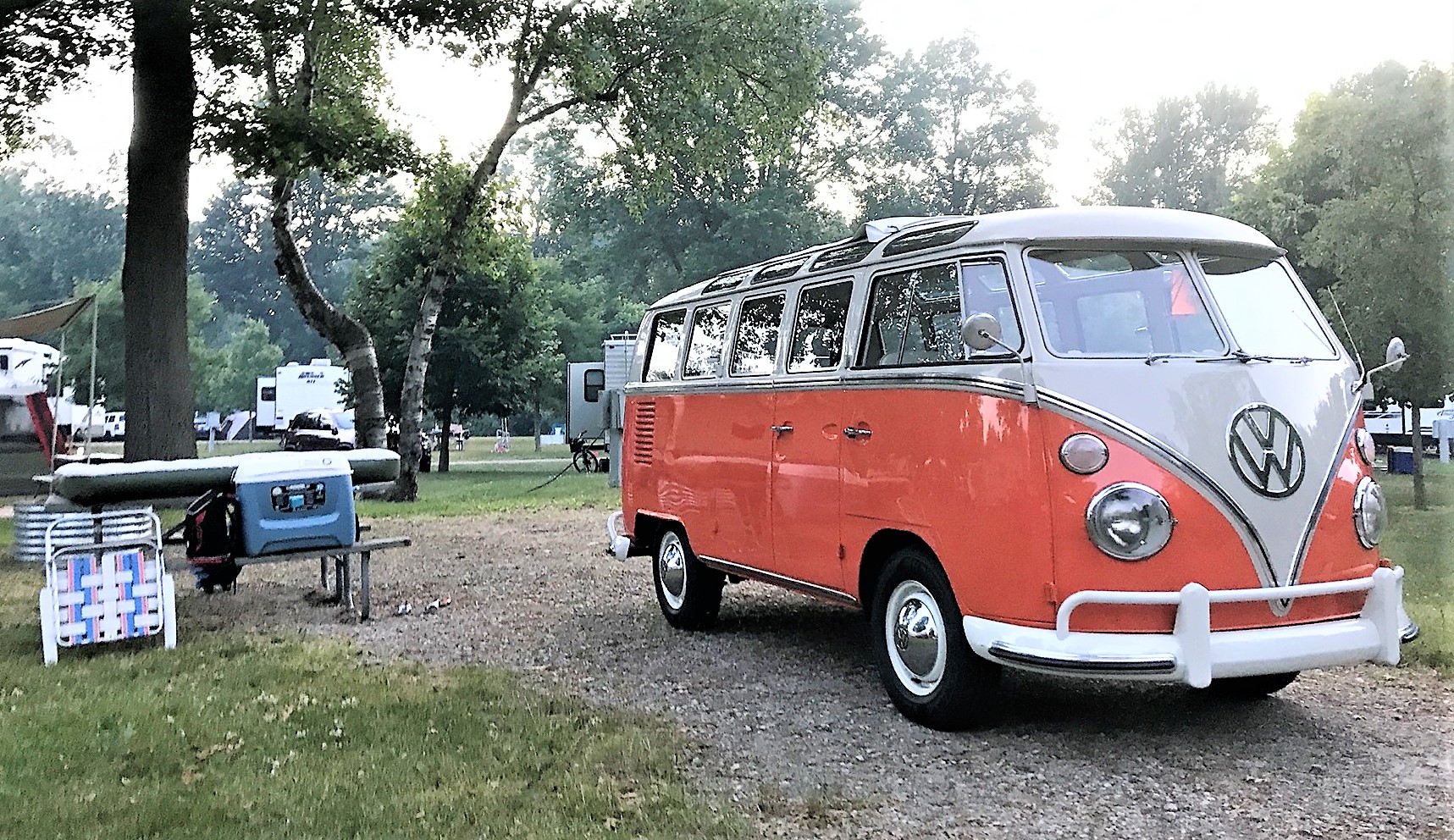
The Deluxe 12-window VW bus at Lake Huron after its journey | Robert Duffer photos
The plan was to plop an air mattress in the 1967 Volkswagen Type 2 Microbus and sleep in a van down by the river. It wasn’t a good plan; it was hardly a plan at all.
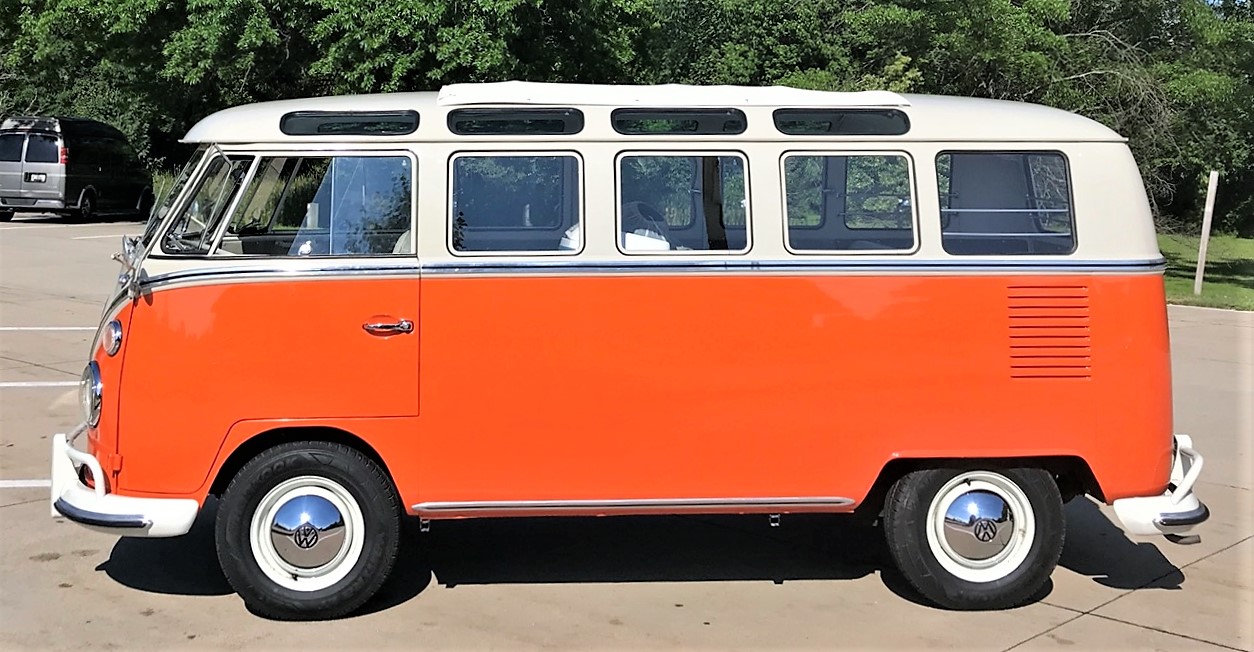
The Deluxe Station Bus painted orange and trimmed in white with white steel wheels and mirrored hubcaps contained three bench seats firmly bolted in place. It would not accommodate a mattress and I did not bring a tent. That would be but the first challenge in taking an international treasure out for an overnight jaunt.
When I picked it up outside of Detroit, where it huddled for attention with five other classic Volkswagens, from a 1984 Rabbit GTI to a Karmann Ghia roadster from the ‘60s, the liftgate above the rear pancake engine jammed open. Eventually, our man on the job, Joe, got it unstuck and I was on my way, puttering down the road, not feeling bad.
Something about that bench seat and the four-on-the-floor manual transmission excited me as much as any other time traveler set to take off. With the front axle underfoot and a split windshield leading the charge, no hood, no exhaust, and 21 glorious windows, anything could happen, except for breaking 70 mph.
The 1493-cc—OK, 1.5-liter—flat-4 engine in this heavily restored example owned by Volkswagen itself makes 53 horsepower, good enough to go from 0-60 mph when it can. Load it up with up to nine passengers and it can’t.
Volkswagen claims an aspirational top speed of 65 mph, but with the right speed, the right wind angle, and a blessing from the goddess Fortuna, the speedometer could hit 70 mph. On the Interstate, the wind pushed the Bus around like a bully and his thugs who only want to be amused. It handled like a boat that mated with a shopping cart to make a Bus, liable to tip, with swoopy sweeping steering demands, torsion bar axles in loose communication front and rear, and enough charm to make me accept that sometimes the destination is a welcome break from the journey.
I knew this piece of collector art on wheels would draw attention but never in my near 30 years of driving cars had I experienced such widespread and unabashed adoration for a vehicle that transcends generations and demographics. Kids waved, teens gawked, passersby—of which there were many in a 53-horsepower car—flashed thumbs, snapped shots, or nodded appreciatively. Boomers of a certain persuasion hustled to shoot it with their iPhones.
RELATED:Eagle builds a Jaguar E-Type Lightweight for the road
One Boomer in particular, with curls unfurling from this fishing cap, leaned on the hood of his truck and waved from the RV park where the road dead-ended and Lake Huron began. Private property surrounded the stamp-sized beach and there were no good angles. I ratcheted the parking brake free and pulled into a driveway to back out. Getting it to reverse was tricky, as promised. It went left of H but not down, then went into second, then went left of H again, and finally, it found that narrow groove into reverse. As I pulled away my Boomer fan had grown into five men, smirking and honoring my efforts with a golf clap. I laughed my ass off.
There’s a lightness to time travel, and it’s impossible to take yourself seriously behind the flat wheel of a Bus.
At the campground of Lakeport State Park on the western edge of Lake Huron, I loosened the wing nuts and propped open the front driver’s window to let in the cool lake breeze. There was no A/C, of course, only a push-button AM radio, an ashtray, and an aftermarket cupholder serving as cabin features. As the sweat cooled on my bald head, heads turned, fingers pointed, and smiles beamed.
The de facto camp host pointed me in the direction of my site and after I finished loading my firewood, he loaded a listing in his iPhone for a 13-window Bus, as if he were in the market, as if his fifth-wheel trailer could fit two Buses.
“Not sure why they call it that,” he said, counting the windows in the listing. “But this one is yours for $57,000.”
Windows are the defining marker of a Type 1 and, later, a Type 2, Bus. Not long after that conversation from the neighboring campsite, an older man with a tye-dyed Buenos Dias shirt and a salt-and-pepper rat tail couldn’t contain his excitement. “That a 23-window? Well, I’ll be.” He had a friend, who had a friend, they were in Costa Rica, some things happened, it was rarer than rare, he concluded, doing two full walk-arounds.
RELATED:How the Porsche crest was created
The standard Microbus, Kombi, or Type 1, depending on your country, came with 11 windows, three on either side, a rear window, two front door windows, and the split windshield. There were 13-window, 15-window, and the famous 23-window Bus that was discontinued for 1964. It featured two rear windows curving around the rear windshield, one more window on either side of the body for four per side, to match the four port windows on either side up top.
Those models with eight roof windows and a manually folding rooftop were known as Sambas. Since mine was a 1967, and didn’t have the curved rear windows, it was a 21-Window Bus—officially, a 1967 Type 2 Microbus 21-Window Deluxe Samba Bus that cost $2,900. It was the last year of the split windshield, the first year of seat belts for all seats. A similar Bus auctioned for $143,000 in 2017.
This one was priceless. It was a smile maker, with a magnetism as infectious as its Day-Glo orange and white body and giant smiling VW logo on its bulbous silly face. Two young women with a Polaroid–yup, those are back, too—snapped some shots and offered me one. Teens too cool to express anything but ennui said with a half-lidded nod, “Cool car.”
It made people want to be a part of it. Before the sun set, there seemed to be a good spot on the wooded dune to shoot it. But it would cramp the walkway to the beach. The first full weekend the Michigan state parks had been opened resulted in a packed house.
Some people wore masks, some didn’t. Some people had campaign signs that read “Our Governor is an IDIOT,” most people maintained a healthy social distance when addressing the Bus.
Camp hostess Jeanette had circled the wagons and flagged down Ranger A., and together, they agreed to help clear a path. They would get nothing out of it but a picture and the satisfaction of helping a stranger.
It was another tricky move, maneuvering the Bus around a swatch of woods on a narrow isthmus of solid ground surrounded by beach sand. Go too far one way, and it could tip into Lake Huron, which, like Lake Michigan, is at record high water levels. Or I could get a wheel stuck in the sand. No way the rear-wheel-drive van could pull itself out of that.
RELATED:Video of the Day: World’s most-beautiful speed-record car
Nothing attracts a crowd, like a crowd of 1967 Type 2 Microbus oglers.
The most frequent comment, after the initial parlay, was “When is that new one coming out?” The Volkswagen ID Buzz Microbus is slated for 2022; it’ll be all-electric and hopefully have a name not as awkward as ID Buzz or as long as Type 2 Microbus 21 Window Deluxe Samba Bus.
Michiganders know the auto industry like southern Californians know the aftermarket. This buckle on the Rust Belt might be known as the home of The Detroit Three (or The Detroit 2.5 if you want to be snarky), but it should be known for its vast recreational opportunities nestled by four Great Lakes.
The enduring image of a Bus on California’s West Coast beaches might be favored in the collective consciousness, but this Bus felt just at home on Michigan’s coast, when it stood out like a Dreamsicle lighthouse amid a sea of trucks and RVs. The comments kept coming, and I kept fielding them.
Now, as then, this timepiece on wheels universally recognized from the counterculture era of the ‘60s, when a country divided took to the road as an expression of freedom, was a gateway to conversation; it was a way to connect with people at a time when disconnect is the prevailing order.
Later, at my fire, as I let my happy thoughts stew around beneath a sky so rich with stars the stardust would blanket my eyes better than the Sandman, I reassessed my situation. I could sleep to those stars, and if the bugs got too buggy, or if the Gypsy moth poop raining down from the oak tree beside me got to be too poopy, I could curl up on a bench seat on the Bus.
Then a pickup truck rumbled to a stop. It was the ranger. He pulled a 10-person tent out of the bed and handed it to me.
“Jeanette said you didn’t have a tent,” he said.
I blushed. I had mentioned it in passing when describing to Jeanette how it wasn’t a camper Bus, how I’d come from Chicago, how she was going back to the office for the first time in three months on Monday and was anxious, how we were all anxious.
I couldn’t turn it down. These were people helping people. This was an act of kindness. I slept that much better in the shadow of the Bus knowing that kindness is not of another era.
This article by Robert Duffer was originally published by Motor Authority, an editorial partner of ClassicCars.com.
Advertisement
For GREAT deals on a new or used Maserati check out Champion Maserati TODAY!