Videos

You are currently browsing articles tagged Videos.

Hennessey Performance Engineering has a different kind of holiday tradition. Most years, CEO John Hennessey sees how fast a car will go with a Christmas tree strapped to the roof.

This year, Hennessey organized a new run up to 183 mph with his wife’s Audi RS 6 Avant. The high-performance wagon was driven by Ford Performance Driving School senior instructor Spencer Geswein. The tree was a 6-foot Douglas fir, in you case you were wondering.

This was actually the second attempt of 2021. Hennessey already tried the stunt earlier this month with a Porsche 911 Turbo S, but wasn’t satisfied with the tree-ladened car’s 175-mph top speed.

Christmas tree reaches 183 mph strapped to a Hennessey-tuned Audi RS 6 Avant

The Porsche’s top speed was slower than the 181-mph top speed achieved by a 1,000-horsepower Hennessey HPE1000 Jeep Grand Cherokee Trackhawk in 2019. Prior to that, the Hennessey team got a Dodge Challenger Hellcat to hit 174 mph with a Christmas tree strapped to its roof.

Aiming to beat the Trackhawk’s record, Hennessey switched to the RS 6 Avant, reasoning that the wagon would be less affected by the extra drag of a tree on the roof. The Audi wasn’t stock (this is Hennessey, after all). The RS 6 Avant’s twin-turbocharged 4.0-liter V-8 makes 591 hp from the factory, but Hennessey claims his wife’s car has 800 hp.

While 183 mph is pretty fast, it also demonstrates the impact of drag at these insane speeds. Audi quotes a 190-mph top speed for the stock RS 6 Avant (when equipped with optional carbon-ceramic brakes), and Hennessey claims the modified version can reach 205 mph unladen. Still, if you want to see the world’s fastest Christmas tree, check out the full video above.

For GREAT deals on a new or used Chevrolet check out Allen Gwynn Chevrolet TODAY!

Tags: , ,

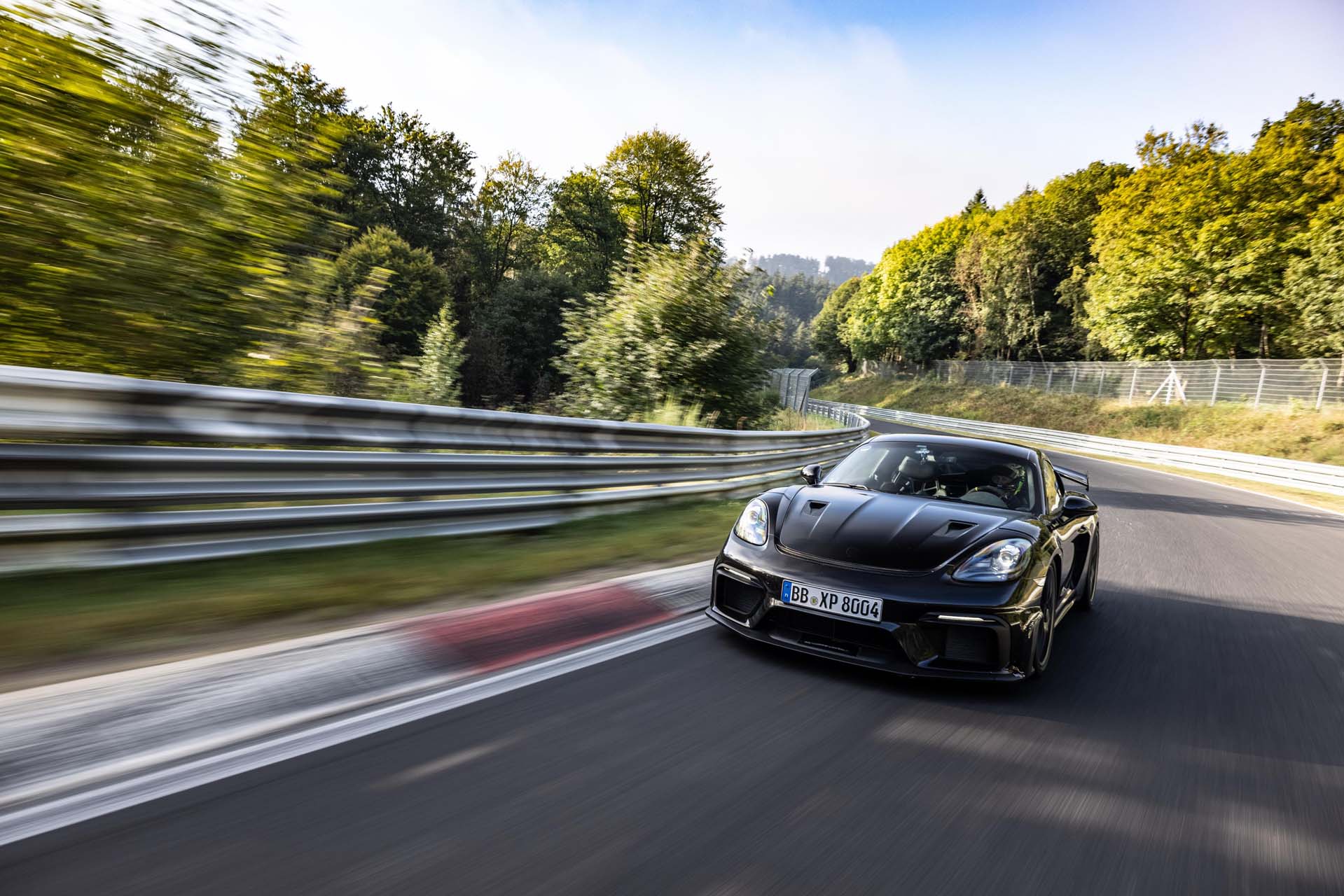
It’s been the stuff of rumors for what seems like forever, but Porsche on Wednesday finally confirmed plans for a new 718 Cayman GT4 RS to cap its mid-engine sports car line.

Prototypes have been out testing for the past couple of years and the debut will finally happen in November, Porsche has confirmed.

The wait will be worth it. Porsche has already clocked a Nürburgring lap time using a production-spec prototype modified only with a race seat and roll cage for safety. The official time for the German racetrack’s full 12.9-mile layout is a blistering 7:09.3.

The time, which was independently verified, was set using Michelin Pilot Sport Cup 2 R tires, which Porsche will offer as an option on the car. And just to put it into some perspective, it’s 3.4 seconds quicker than Porsche’s own time for the 991.2 911 GT3. It’s also more than 20 seconds quicker than the time for the regular 718 Cayman GT4, the car on which this new RS variant is based.

[embedded content]

Porsche is holding back specs for now but said the changes made to the 718 Cayman GT4 include all the usual RS upgrades, such as weight-saving mods, increased downforce (notice the new rear wing?), improved responsiveness and driver feedback, and, of course, more power.

And importantly, the nimble, almost go-kart like handling of the 718 Cayman GT4 has been retained with the car’s transformation into an RS, according to Jörg Bergmeister, Porsche development driver and the man responsible for setting the ‘Ring time.

Power in the 718 Cayman GT4 RS is expected to come from an uprated version of the 4.0-liter flat-6 found in the 718 Cayman GT4. We expect an increase from the GT4’s 414-hp rating to something closer to 450 hp in the GT4 RS, thanks in part to elements borrowed from the 992 911 GT3’s 4.0-liter engine. Drive will be to the rear wheels, likely via a 7-speed dual-clutch transmission which was made available on the GT4 last year.

Stay tuned for the reveal next month.

For GREAT deals on a new or used Chevrolet check out Paradise Chevrolet Ventura TODAY!

Tags: ,

Despite an $8.9 million price tag, the Bugatti Centodieci is already sold out. So one person decided to make their own, albeit a bit smaller, and using wood.

Documented in multiple videos on the YouTube channel “ND - Woodworking Art,” the mini Centodieci (it looks to be about the size of a child’s Power Wheels car) was carved out of wood like the sculptures you see at craft fairs and roadside gift shops.

This isn’t the first car build featured on the channel. You can also check out a Ferrari LaFerrari Aperta and BMW 328 Homage concept, plus videos of wooden iPhones and machine guns. 

[embedded content]

The Centodieci can move under its own power, thanks to a small electric motor, and captures key details of the full-size version, including stacked exhaust tips, a large rear spoiler, and an intricate front end featuring the Bugatti grille flanked by blade-like horizontal elements.

Unveiled during 2019 Monterey Car Week, the real Centodieci is a tribute to the Bugatti EB110, the product of a brief attempt to revive Bugatti in the 1990s before the brand was bought by the Volkswagen Group. That Bugatti revival, helmed by Italian businessman Romano Artioli, was unsuccessful, but the EB110 was one of the most impressive supercars of its day, and it brought the Bugatti name back from the dead.

“Centodieci” means “110” in Italian, referencing the EB110 name, which in turn commemorated the 110th birthday of company founder Ettore Bugatti. The car is based on the Bugatti Chiron, but with different bodywork inspired by its 1990s namesake, and a W-16 engine producing 1,577 hp—97 hp more than the Chiron. Development work is still ongoing, but Bugatti expects to deliver the first of the 10 customer cars in 2022.

For GREAT deals on a new or used Toyota check out Norwalk Toyota TODAY!

Tags: , , ,

Porsche has only just launched the new GT3 based on the 992-generation 911, but the more hardcore GT3 RS variant is already nearing the final stage of testing.

A prototype has been spotted again at the Nürburgring and on some of the German racetrack’s surrounding roads, and it gives us a number of clues about the new track superstar.

Compared to the GT3, the tester for the GT3 RS sports additional vents on the hood and front fenders which look to contain some active elements. There’s also a more aggressive front splitter, new side skirts, and a massive, dual-element rear wing with swan-neck struts. As the spy video shows, the wing also has an active element.

[embedded content]

The GT3 RS prototype also wears Michelin Pilot Sport Cup 2 tires measuring 265/35R20 up front and what looks to be 325/30R21 at the rear. Huge carbon-ceramic brake rotors can also be seen housed within the center-lock wheels.

The engineers have also attempted to hide the car’s side intakes which are a typical feature of the GT3 RS, but not the GT3.

Power will likely come from a 4.0-liter flat-6 mated as standard to an 8-speed dual-clutch transmission. Peak output in the previous GT3 RS was 520 hp and 346 lb-ft of torque from the same type of engine, and we can expect a slight uptick for the new generation.

2023 Porsche 911 GT3 RS spy shots - Photo credit: S. Baldauf/SB-Medien

2023 Porsche 911 GT3 RS spy shots - Photo credit: S. Baldauf/SB-Medien

While the GT3 is closely related to Porsche’s 911 GT3 Cup race car, the GT3 RS takes after the more extreme 911 GT3 R racer. Porsche has also been spotted testing the new GT3 R based on the 992-generation 911, with the race car’s development likely closely associated with this new GT3 RS. Recall, Porsche’s GT3 and GT3 RS are built alongside their motorsport siblings.

One element from racing unique to the GT3 and thus also likely on this GT3 RS is a double-wishbone front suspension that’s stiffer and more stable with less body movements under braking compared to the MacPherson strut used in other 911 variants.

We expect the new GT3 RS to debut in 2022 as a 2023 model. The related GT3 R race car is also expected in 2022.

For GREAT deals on a new or used Cadillac check out Carter Cadillac TODAY!

Tags: ,

Acura stopped selling the RLX in the United States after 2020 but the flagship sedan is still available in other markets where it’s sold by Honda as the Legend.

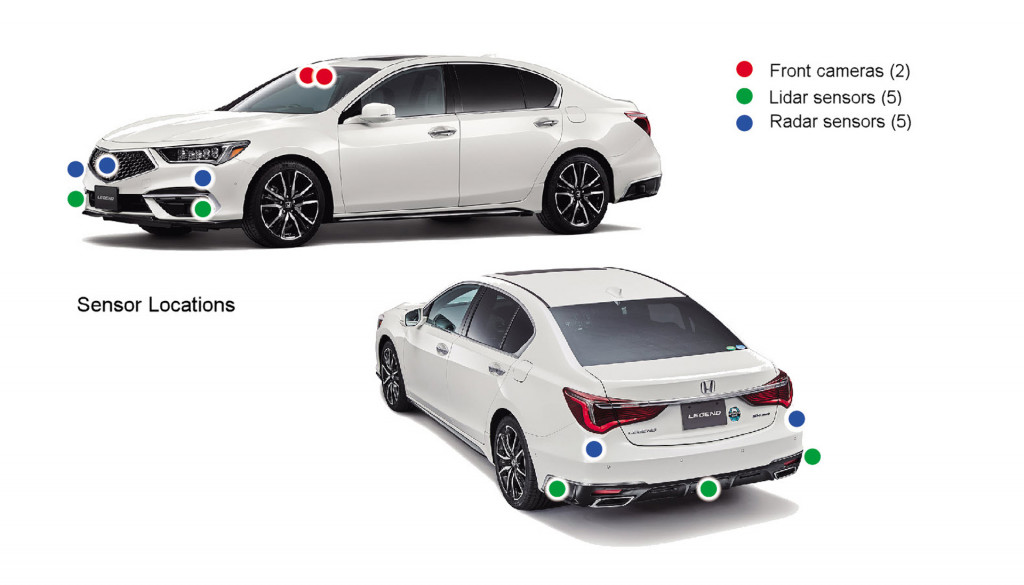
Honda on Thursday unveiled an updated Legend for the Japanese market and one of the car’s key features is an electronic driver-assist feature rated at Level 3 on the SAE scale of self-driving capability. Level 3 means a car that can handle itself in certain conditions, enabling the driver to let go of the steering wheel and even look away from the road for moments at a time.

[embedded content]

The Legend’s self-driving system is part of a new Honda Sensing Elite suite of electronic driver-assist features. It can handle traffic jams and highway driving on its own, though with some restrictions. For example, the traffic jam function only works under certain slow speed conditions. When it use, the driver is free to use the infotainment screen for entertainment purposes.

The highway function is a little more complicated. It only works where there is sufficient map data that the system uses together with GPS data and onboard sensors to position the vehicle. At the same time, the system tracks the condition of the driver using a monitoring camera mounted inside the vehicle.

2021 Honda Legend (Japanese spec)

2021 Honda Legend (Japanese spec)

The system is smart enough to handle lane changes on its own, like when there is a slow moving vehicle ahead. The system will first notify the driver and then perform the maneuver. There’s also a lane change assist feature where the driver chooses when to change lanes by activating the indicator, and the system then handles the maneuver.

While the driver doesn’t need to hold the steering wheel when the system is activated, he or she still needs to be ready to take back control at any moment, so monitoring the road ahead is required. Should the driver be unresponsive to prompts to take back control, the system is designed to bring the vehicle to a safe stop on the outermost lane or the shoulder. It will also flash the hazard lights and sound the horn at this point to warn other drivers.

2021 Honda Legend (Japanese spec)

2021 Honda Legend (Japanese spec)

While other automakers have shown vehicles with Level 3 self-driving systems, Honda is the first to offer it for sale, albeit only in Japan at present. This is because Japan is the only country that has approved it.

Why the delay elsewhere? Regulations are lacking because Level 3 self-driving systems fall into a bit of a regulatory gray area. Because drivers need to be ready to take back control at a moment’s notice, many companies and regulatory bodies are looking further out to Level 4 self-driving systems that can handle a car on their own for extended periods without any intervention and can give a driver ample warning should he or she need to take back control. The final goal is a Level 5 self-driving system which is a system that can drive at the same level as a human.

Tags: ,

It’s difficult for new mid-size luxury sedans to break through the groupthink that sways drivers into the seats of the German Big Three. The Benz E-Class, the BMW 5-Series, and the Audi A6/A7 have a stranglehold on a niche that’s equal parts size, price, and prestige.

That’s not to say they have lacked serious challengers, like the well-loved and now-gone Cadillac CTS—and the Genesis G80. In just a few years, Hyundai’s Genesis brand has needled its way into the conversation despite being saddled by a small dealer footprint, no name recognition, and the lack of an SUV in its showrooms until this year (that’s solved with the 2021 Genesis GV80). 

Today’s Genesis has a consistently excellent field of vehicles in its lineup. The 2021 Genesis G80 underscores that growing credibility, and pitches itself closer to stardom. On a shared architecture with the GV80, it’s lovely to look at, user-friendly, bursting at its seams with technology, and eager to win friends with a lavish warranty and service.  

2021 Genesis G80

2021 Genesis G80

2021 Genesis G80

2021 Genesis G80

Master strokes

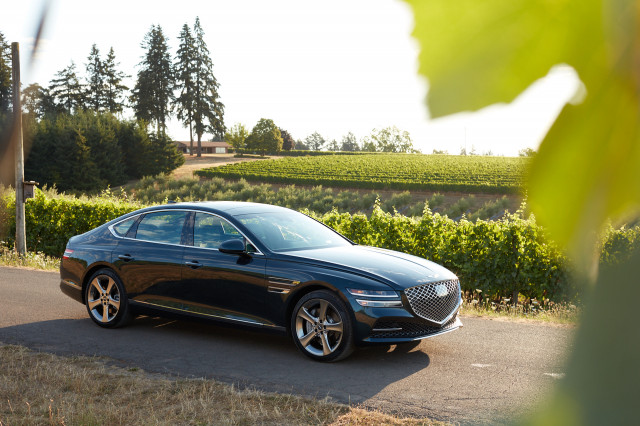
The G80’s leading masterstroke is its body. The car retains the long hood, short-deck design of its predecessor but now looks wider and more hunkered down, resulting in a powerful stance. You’ll also find all the latest Genesis styling cues like the crest grille, a kammback rear, and quad-light arrangement at both ends. The headlights and taillights try a little too hard to earn their LED stripes, and there’s some thickness at the rear pillars that probably helps it translate into an SUV more easily, but in all, the G80’s a stunning shape with the poise of an archer.

The interior shares the GV80’s sensible and sensual appeal, albeit with some subtle differences like the placing of a few controls. The dash sits low, slathered in skintight leather and graced with a billboard of a touchscreen. The cockpit is an overachiever in the design and materials, and glints with hints of metallic trim that coordinate with its leather and open-pore wood, though in base trim those latter two get hot-swapped for synthetic leather and piano-black accents. It’s still an inviting and soothing atmosphere that’s second to none: the high quality of its assembly is apparent even to people who aren’t so picky about stuff like French seams and nappa hides. (We call them savages.)

2021 Genesis G80

Blazing a digital trail

Technology suits up to play offense in the 2021 G80. The focal point is a 14.5-inch split-screen infotainment system that sits at the top of the dash. It’s controlled both by hard buttons and a center console-mounted controller with handwriting recognition. 

The system backfires as a backup for steering-wheel controls and voice commands. For starters, it inverts the commonly understood interface of a clickwheel; users must spin its metallic ring then tap on its perimeter to log in a command. It’s physically awkward  and spatially vague all at once. It takes too much motion to register what could be done with a single poke of the touchscreen—if only that billboard of a screen didn’t lie out of arm’s reach for most of us. And somehow, it corrupts Apple CarPlay and Android Auto interfaces into kludgy software. 

The digital displays get better elsewhere. Base models come with analog gauges and an 8.0-inch screen in the instrument cluster, but pricey versions add a full digital gauge cluster that toggles through views to deliver data on tire pressures, satellite radio stations, and more. There’s a neatly rended head-up display on the order sheet, too. 
2021 Genesis G80

2021 Genesis G80

The wheel deal

The 2021 G80 banks on a new platform and lightness to deliver big handling gains versus its previous incarnation. Underpinning the vehicle is a modified version of the brand-exclusive M3 rear-wheel-drive platform that debuted in the GV80. Thanks to the use of lightweight materials in the platform’s construction, particularly aluminum, the new G80 weighs around 243 pounds less than its predecessor. Curb weight still checks in at 3,957 pounds in base 2.5T RWD spec, 4,497 pounds in top-end 3.5T AWD trim.

The use of the M3 platform also means powertrain options in the G80 match those of its SUV sibling. The base engine is a 2.5-liter turbo-4 with 300 horsepower and 311 pound-feet of torque; above this is a newly developed 3.5-liter twin-turbo V-6 with 375 hp and 391 lb-ft of torque. In both cases an 8-speed auto is standard. 

We were split between coasts for drives. Bengt Halvorson says he found the turbo-4 perky enough, but not truly lively until dialed into Sport mode, with acceleration to 60 mph likely in the seven-second range. “This is a luxury car with performance flair,” he writes. “You might as well go big under the hood.”

I’m in sync there. I arrowed from Atlanta to the foot of the Appalachian Trail in the G80 3.5T AWD, and tapped its 375 hp to snip ahead between slower cars over dashed yellow lines and to loaf at an easy 80-mph clip on the way back into the Perimeter. The V-6 does the best impression of the late, lamented 5.0-liter V-8 formerly available; though the 8-speed and the Genesis’ comfort drive mode aren’t eager to jump off the line, a spin into Sport mode and a full mash on the pedal kicks it into hyperdrive, with some urgent hustle to go with its bucketfuls of panache.

Grip isn’t the question in the all-wheel-drive edition, thanks to its orderly transfer of power from the rears to the front, and to big 20-inch wheels. The G80’s adaptive suspension brings up the uncertainty: is it too relaxed, or too eager? It can be both. As we found in our drive of the GV80, the G80 seems too softly set in its comfort mode, a little too edged in its sport setting. 

Genesis’ hardware might benefit from some deeper coding: the continuously adaptive shocks take their lead from a single camera that reads the road ahead and signals for more or less damping, depending on obstacles it sees. On Atlanta’s ring road it pattered and thunked with minor ripples in the road; on wide smooth bends, it bounded until I dialed it into Sport mode, where it filed off all those edges into a more uniform ride motion. There’s an Individual drive mode that allows that suspension setting to be paired with a calmer setup for the transmission and throttle delivery. 

With the turbo-4 the G80 omits the adaptive dampers. Halvorson reports that it rides well over most surfaces, with confident straight-ahead tracking and a tight, near silent cabin amid some gusty crosswinds. He said the setup feels “like a good, relatively firm sweet spot for most situations—albeit too soft for performance driving.”

Nitpicks aside, the G80’s a fabulous car that drives well. We’d just be keen to sample a rear-drive 3.5T without adaptive damping—something that’s not currently on the menu.

2021 Genesis G80

Space, price and features

The G80’s well-suited to carry four adults and some weekend bags. Upgrading from the turbo-4 car to the turbo-6 nets a bunch of upgrades—leather from the synthetic stuff, more bolstering, quilted stitching—but it doesn’t change the fundamentals. The G80 makes the most of its spacious cabin with fantastic front seats that heat, cool, slide, puff, and snuggle in myriad ways. Genesis sculpts the back seats into supportive nacelles for outboard passengers, but boxes in a flat section in the middle for an unlucky fifth wheel. You might as well keep the wide, plush-looking center console with built-in cupholders folded down. The trunk’s only 13.1 cubic feet, too, so a fifth person better not have any carry-ons, either.

Safety technology carries on Genesis’ reputation for a plethora of technology. Standard are adaptive cruise control, automatic emergency braking, and blind-spot monitors; the options list includes a surround-view camera system and remote park assist, where they’re not standard. 

Every G80, even the base $48,725 G80 2.5T RWD, also comes with LED headlights, 18-inch wheels, synthetic leather upholstery, 12-way power heated front seats, and a 14.5-inch touchscreen infotainment system with Apple CarPlay and Android Auto compatibility. Options range from 19- or 20-inch wheels to matte wood trim, 21-speaker Lexicon audio, heated rear seats (on rear-drive models), and wireless smartphone charging.

The G80 3.5T AWD I drove checked in at $69,075, including $400 of Himalayan Gray paint and a Havana Brown interior, along with the electronically controlled suspension, 20-inch wheels, a panoramic sunroof, nappa leather, the surround-view camera system, and blind-spot cameras that project obstacles into the gauge cluster. It’s a features list worthy of a starring role—one the 2021 G80 acts out beautifully.

_______

Genesis delivered a car full of gas to our driveway so we could hustle to the North Georgia mountains and back.

Tags:

Nissan on Wednesday provided a first glimpse at its Ariya electric crossover SUV due to be revealed on July 15.

The vehicle is the production version of the Ariya concept shown at the 2019 Tokyo Motor Show, and Nissan describes it as a global vehicle meaning we’re likely to see it reach the United States.

The Ariya rides on a dedicated EV platform and is expected to be the first recipient of Nissan’s new e-4ORCE dual-motor all-wheel-drive system. A prototype version of the system with a combined 300 horsepower and 500 pound-feet of torque was shown in June.

Nissan Ariya Concept

Based on the dimensions of the the Ariya concept, the production version should be slightly smaller than the Rogue, though space in its cabin should be comparable thanks to the packaging advantages of its EV platform. Similar sized EVs include the Hyundai Kona Electric and upcoming Chevrolet Bolt EUV and Volkswagen ID 4.

Nissan is quiet on details but says to expect the latest in in-car technology. The Ariya concept had a 12.3-inch infotainment screen, a remote parking feature, and Nissan’s ProPilot 2.0 semi-autonomous driver-assist feature for highway driving.

The Ariya is part of a major product renewal at Nissan as the automaker seeks to turn around its losses. There are multiple new or updated models in the pipeline including redesigned versions of the Frontier pickup truck and Z sports car. The first model in the product renewal has already been revealed in the form of the 2021 Rogue.

Tags:

You may have seen engines test on dynamometers, but Rimac does the same thing with its batteries designed for electric hypercars. As with engine dyno testing, this ensures batteries meet performance targets and handle real-world use.

Rimac simulates everything a battery might experience in a car, including acceleration, charging, track use, and highway driving, CEO Mate Rimac explains in a video from YouTube channel Apex One. By running these simulations 24/7, engineers can more or less replicate a lifetime of use in a few months, he said.

Engineers can get all of the data they need while batteries sit on a test stand. While developing batteries for the Koenigsegg Regera hybrid, Rimac simulated a 0-400 kph (0-248 mph) acceleration run this way.

Koenigsegg Regera in bare carbon fiber - Image via Keno Zache Photography/Carage

During tests, engineers monitor many different parameters, including the voltage and temperature of each individual battery cell, as well as temperature of the entire battery pack. Cells are individually selected for use in a given pack, so their characteristics are as consistent as possible.

“If, out of the thousands of cells inside of the car, there is one or multiple cells that are performing worse than the others, that’s going to be your limit,” Rimac said. Any weak cells can be traced back to their point of origin, he added.

As with internal-combustion engines, batteries work best under very specific conditions. Testing helps figure out what the best operating range is, Rimac said.

Rimac C_Two prototype

When a battery is discharged during testing, the electricity is sent into the grid, which has created a bit of a problem for the automaker.

“The electric company doesn’t really like that,” Rimac said.

In addition to developing a battery pack for Koenigsegg, Rimac will supply a pack for the Aston Martin Valkyrie, and will work with Hyundai on an all-electric N sports car. Rimac is working to get its own second-generation electric supercar—the C_Two—into production.

Tags: ,